August 11, 2026 · The Tamara Team
Your Business Does Not Need the Biggest AI Model for Every Task
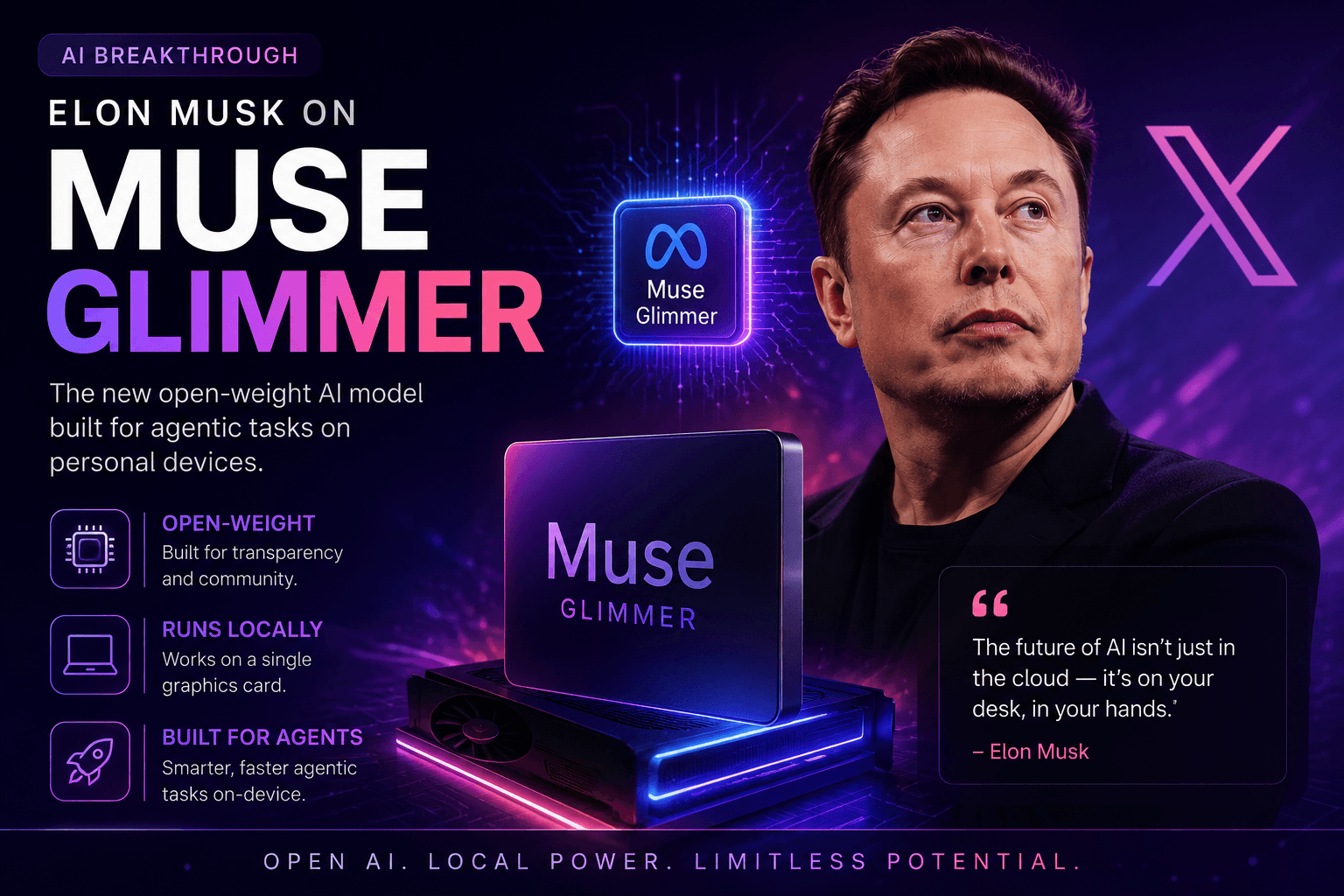
Meta has launched another artificial-intelligence model.
That alone would not be particularly surprising in 2026.
What makes Muse Glimmer interesting is where Meta expects some of the intelligence to run.
On the device.
According to Reuters, Muse Glimmer is an open-weight model designed for smaller agentic tasks and capable of running on a personal device using a single graphics card.
It arrives as Meta CEO Mark Zuckerberg pushes for broader adoption of open-weight artificial intelligence and argues against concentrating advanced AI capability among a handful of closed providers.
For businesses, the important part is not the debate between Meta and its competitors.
It is the architecture.
We are moving toward a world where every AI task does not necessarily need to travel to a giant cloud model.
And that could change the economics of business automation.
We have been using large AI models for small jobs
Generative AI adoption has followed a predictable pattern.
A company selects a powerful AI model.
Then it sends almost everything to that model.
Write an email.
Classify a customer request.
Extract a telephone number.
Summarise a meeting.
Determine whether someone wants an appointment.
Rewrite a sentence.
Identify the topic of a support ticket.
These are useful tasks.
But many of them do not require the most capable artificial-intelligence model available.
It is similar to hiring a senior financial analyst and asking them to spend the morning alphabetising invoices.
The analyst can perform the task.
That does not make it the best use of their capability.
AI systems need the same thinking.
Intelligence should match the job
A business should not ask:
"What is the most powerful AI model we can connect?"
It should ask:
"What is the minimum level of intelligence required to complete this particular step reliably?"
That changes architecture.
Imagine a customer calls a business.
The first question may simply be:
What does this customer want?
Appointment?
Price enquiry?
Complaint?
Existing booking?
Payment issue?
Human employee?
A smaller local model may eventually be perfectly capable of classifying that request.
It does not necessarily need the strongest cloud model on the market.
Then the workflow can decide what happens next.
Local AI and cloud AI are not enemies
Discussions about AI architecture often become unnecessarily binary.
Cloud or local.
Open or closed.
Small or large.
The better answer may be:
All of them, where appropriate.
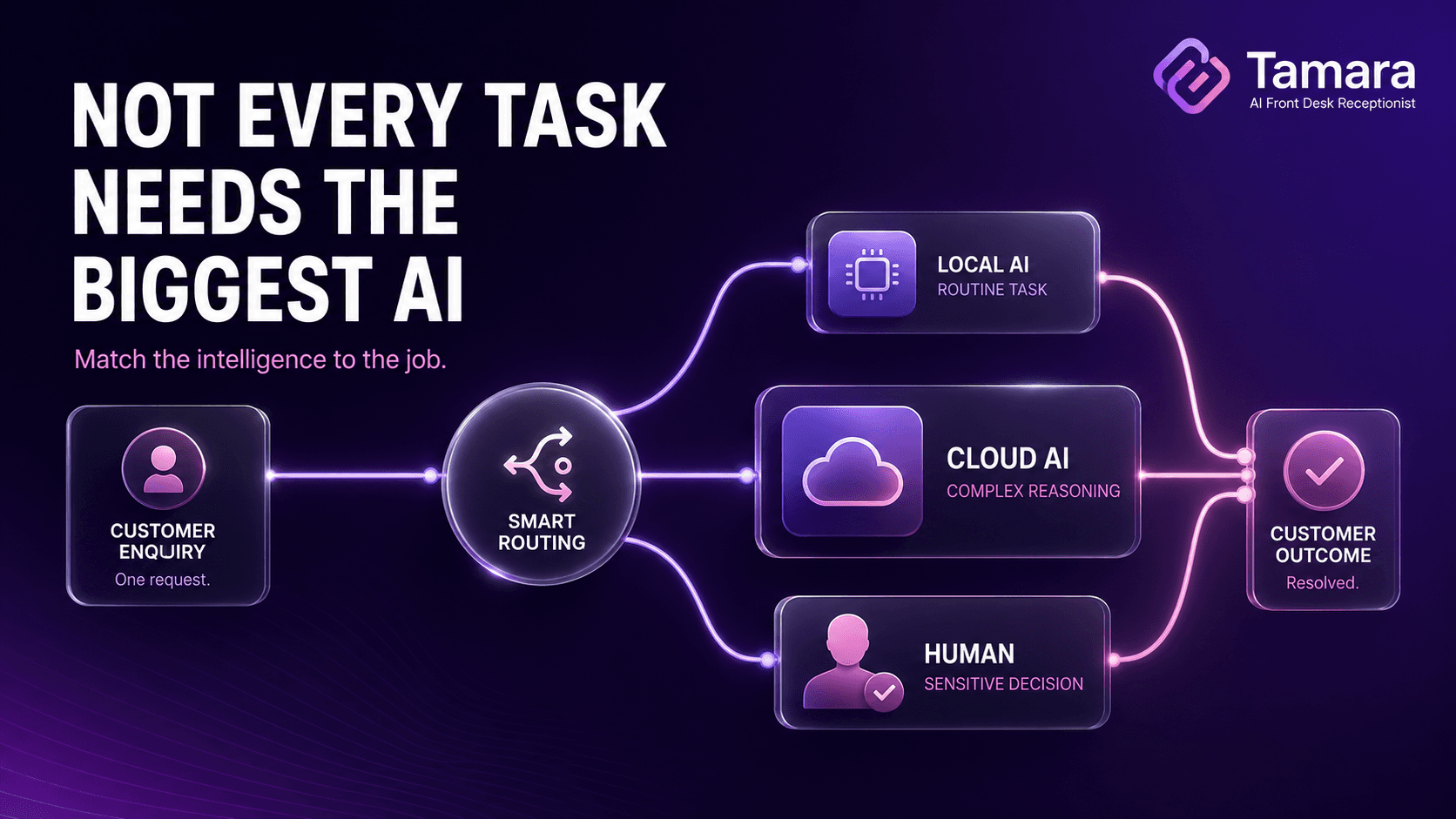
A practical system could use local AI for predictable tasks and cloud AI for difficult tasks.
For example:
LOCAL MODEL
Identify customer intent.
Extract name and telephone number.
Summarise routine notes.
Detect the language.
Classify the department.
Search a small approved knowledge base.
CLOUD MODEL
Handle complicated reasoning.
Interpret ambiguous customer situations.
Analyse a large collection of information.
Generate complex personalised responses.
Coordinate difficult multi-step tasks.
HUMAN
Approve significant refunds.
Resolve complaints involving judgement.
Handle emergencies.
Review fraud concerns.
Make regulated or irreversible decisions.
That is not a competition between humans and AI.
It is workflow design.
Why local processing matters
Running some AI tasks closer to the device can potentially create several advantages.
The first is latency.
Every time a request travels across the internet to a remote AI service, the customer waits.
The delay may be small.
During a voice conversation, small delays become noticeable quickly.
People naturally expect conversation to flow.
If parts of the interaction can happen closer to the user, the system may respond faster.
The second advantage is resilience.
A cloud service may experience:
Downtime.
Network problems.
Regional disruption.
API limits.
Temporary capacity constraints.
A local component may allow some functionality to continue when the remote service is unavailable.
The third advantage is cost.
Cloud AI is usually priced according to usage.
Every request has a cost.
A small cost multiplied by millions of interactions becomes meaningful.
If routine tasks can run locally after infrastructure has been purchased or provisioned, some variable costs may decline.
The fourth advantage is data control.
Some information may not need to leave the environment where it was created.
That does not automatically make local AI secure.
It can, however, reduce unnecessary data movement when the surrounding architecture is designed properly.
Tamara does not need maximum intelligence for every sentence
Consider Tamara.
Tamara is an AI-powered front desk receptionist.
A customer calls and says:
"Hello, I need to move my appointment from Wednesday to Friday."
Several tasks happen inside that sentence.
Speech becomes text.
The system identifies the customer.
The intent is detected as rescheduling.
The existing appointment is located.
Friday availability is checked.
The new appointment is confirmed.
A message is sent.
Does every step require a frontier model?
Probably not.
Intent classification is relatively simple.
Calendar retrieval should be deterministic.
Date availability should come from the calendar.
The final booking should follow business rules.
AI may help understand natural language.
The rest of the system should do its own job.
AI should not replace ordinary software where ordinary software works better
This is one of the most important principles in AI automation.
Do not use artificial intelligence simply because artificial intelligence exists.
Suppose a customer asks:
"Is Friday at 3 p.m. available?"
AI can understand the sentence.
But AI should not guess whether the time is available.
The calendar should answer that question.
Suppose a customer asks:
"How much does the premium package cost?"
AI may interpret the request.
The approved pricing database should provide the number.
Suppose a customer asks:
"Has my payment arrived?"
AI may understand the question.
The payment system should determine the transaction status.
The model interprets language.
Business systems establish facts.
That distinction improves reliability.
The model should be one layer
A mature AI architecture might contain several layers.
Layer 1: Customer channel
Phone.
WhatsApp.
Website.
Email.
Mobile application.
Layer 2: Basic interpretation
Speech recognition.
Language detection.
Intent classification.
Information extraction.
Layer 3: Business knowledge
Approved FAQs.
Services.
Prices.
Policies.
Customer-specific information.
Layer 4: Workflow
Booking.
Lead capture.
Support ticket.
Payment status.
Customer verification.
Layer 5: Advanced reasoning
A more capable AI model handles unusual or complex situations.
Layer 6: Human authority
Employees review issues involving judgement, regulation, security or significant financial consequences.
The customer experiences one service.
The architecture decides how much intelligence is required.
Small models can become the reception layer
This is where Meta's Muse Glimmer release becomes strategically interesting.
If capable smaller models increasingly run locally, businesses could potentially place intelligence at the front of the workflow.
The local model handles the first decision.
What does the customer need?
Can this request be answered safely from approved information?
Does this task require the cloud?
Does this request require a human?
Think of it as triage.
A hospital does not send every patient immediately to the most specialised surgeon.
The first stage determines what level of care is appropriate.
AI systems can do something similar.
Routing can dramatically change economics
Suppose a company processes 100,000 customer interactions every month.
Imagine that:
60 percent are routine.
25 percent require moderate reasoning.
10 percent require advanced reasoning.
5 percent require a person.
If every interaction uses the strongest AI model from beginning to end, the company pays premium processing costs for all 100,000 conversations.
A routing architecture changes that.
Routine interactions use the lowest-cost reliable system.
Moderate interactions use a stronger model.
Complex interactions receive frontier-level intelligence.
Sensitive interactions reach employees.
The business pays for intelligence where intelligence creates value.
Cheap does not mean good
There is an important warning.
A smaller model is not automatically the better choice.
If the model repeatedly misunderstands customers, the savings disappear.
The company may experience:
Incorrect appointments.
Customer frustration.
Repeat calls.
Employee corrections.
Lost sales.
Complaints.
The correct metric remains:
Cost per successful outcome.
Not:
Cost per model request.
A five-times-cheaper model that doubles your failure rate may be expensive operationally.
Every model should be tested on the real workflow.
Test local AI using real business examples
Suppose you are evaluating a smaller model for customer-intent classification.
Do not test only obvious examples.
"Book appointment."
is easy.
Use real situations.
"I spoke to someone yesterday and she said I could come around after lunch but I cannot remember the name."
"I've been charged but I haven't received any confirmation."
"My wife booked something for Friday but I need to know whether you have anything earlier."
"I don't want to cancel completely. Can I move it?"
"Can somebody explain why this amount is different from what I paid last month?"
These examples reveal whether the model understands customer language rather than benchmark questions.
Local AI does not eliminate security requirements
There is another misconception worth avoiding.
Local does not automatically mean safe.
A model running on your own hardware can still:
Access information it should not see.
Use insecure software.
Produce incorrect output.
Expose information through poor configuration.
Become outdated.
Be manipulated through external input.
Security still requires:
Permission controls.
Authentication.
Encryption.
Logging.
Software updates.
Data classification.
Access restrictions.
Human oversight.
Local processing changes where computation occurs.
It does not eliminate governance.
Open-weight does not mean unlimited use
Meta's model is also open-weight.
That can provide businesses with more flexibility around deployment and customisation.
But businesses should still review:
Licensing.
Commercial-use terms.
Model updates.
Security responsibilities.
Data requirements.
Hardware requirements.
Support arrangements.
Open access to model weights does not remove operational responsibility.
The business becomes responsible for more of the stack.
That can be an advantage for capable organisations.
It can also create work.
Cloud providers still matter
Local AI does not mean cloud AI disappears.
The largest models remain extremely useful for complicated work.
Cloud providers also handle difficult infrastructure problems.
They manage:
Large-scale computing.
Model updates.
Availability.
Security infrastructure.
Load balancing.
Model optimisation.
Global deployment.
For many smaller businesses, cloud AI remains the easiest starting point.
The strategic opportunity is optionality.
Use cloud intelligence when you need it.
Do not automatically send every trivial task there.
AI infrastructure is becoming extremely expensive
This matters because the cloud behind AI is undergoing a historic expansion.
Nvidia is partnering with major financial institutions including BlackRock, Blackstone, Goldman Sachs and KKR on financing platforms expected to attract more than $500 billion for AI infrastructure.
At the same time, lenders are becoming increasingly cautious about some data-centre projects because of permitting risks, local opposition, electricity demand, water use and environmental concerns.
These stories reveal something important.
Cloud AI can feel invisible when you type into a box.
The infrastructure is not invisible.
It requires:
Land.
Power.
Cooling.
Servers.
Semiconductors.
Financing.
Networks.
Permits.
Construction.
AI usage ultimately reflects some of those costs.
Efficiency therefore matters.
Do not use AI where a rule will work
Consider another example.
A business says:
"No refunds above ₦50,000 without manager approval."
You do not need an AI model to decide whether ₦75,000 exceeds ₦50,000.
That is a rule.
Another example:
"Appointments cannot be booked after 6 p.m."
Rule.
"Customers must verify identity before changing payment details."
Rule.
"Transfer complaints mentioning fraud to the risk team."
Potentially a combination of AI classification and a deterministic rule.
Good automation separates interpretation from authority.
AI can understand.
Rules can constrain.
Systems can execute.
People can approve.
This creates a more reliable customer journey
Imagine the customer says:
"I was supposed to receive a refund, but the card I used has expired. Can you send the money to this bank account instead?"
A smaller model may recognise:
Refund issue.
Payment-destination change.
Sensitive financial request.
The workflow sees that changing payment destinations is a high-risk action.
Tamara does not attempt to solve everything.
Tamara says:
"I can help you get this reviewed. Changes to refund details require additional verification, so I will securely pass this to the appropriate team."
The system captured the request.
It understood the need.
It protected the customer.
It avoided pretending that conversational intelligence equals financial authority.
That is good automation.
Business AI should degrade gracefully
A useful system should also ask:
What happens when the strongest AI is unavailable?
Suppose the cloud model goes down.
Could Tamara still:
Answer opening hours?
Capture the caller's name?
Record their telephone number?
Identify whether the enquiry is sales or support?
Create a callback request?
Provide approved directions?
If yes, the business has graceful degradation.
The service becomes less intelligent temporarily.
It does not disappear completely.
This can be a major operational advantage.
Local AI may be particularly useful in emerging markets
There is another angle relevant to businesses operating in markets where connectivity can be inconsistent or expensive.
A system dependent on constant high-quality cloud connectivity may struggle when networks degrade.
Some local processing can potentially reduce reliance on continuous remote access.
This does not mean running advanced AI entirely offline is practical for every company today.
The strategic direction matters.
Businesses in emerging markets should pay particular attention to models designed for lower-cost hardware and more local execution.
The winning technology may not always be the largest model.
It may be the model that works reliably under real operating conditions.
Measure latency as a customer metric
Companies measure AI accuracy.
They should also measure waiting.
For voice applications, track:
Time from customer finishing a sentence to response beginning.
Time to identify intent.
Time to retrieve information.
Time to complete the action.
Total conversation duration.
Number of repeated questions.
Customer interruptions.
Long pauses make AI feel unintelligent even when the final answer is correct.
Reducing unnecessary cloud calls could help make some workflows feel more natural.
Build a routing policy
A company does not need a complicated system to begin thinking this way.
Create three categories.
ROUTE A: SIMPLE
Examples:
Opening hours.
Location.
Basic service information.
Intent classification.
Appointment type.
Use low-cost or local processing where reliable.
ROUTE B: COMPLEX
Examples:
Ambiguous questions.
Long customer histories.
Multiple connected requests.
Complicated policy interpretation.
Use stronger cloud reasoning.
ROUTE C: SENSITIVE
Examples:
High-value refund.
Fraud.
Customer identity change.
Medical emergency.
Legal threat.
Privileged system access.
Use human approval or direct escalation.
The system does not need maximum intelligence at every stage.
It needs correct routing.
Create confidence thresholds
Routing can also depend on confidence.
Suppose the smaller model is 98 percent confident that the customer wants to book an appointment.
Proceed.
Suppose confidence is 63 percent.
Ask a clarification question.
Suppose the system identifies possible fraud.
Escalate.
This is more responsible than forcing the AI to pretend it understands every situation.
"I am not certain" can be valuable operational information.
Your AI stack should become replaceable
Smaller models also reinforce another important design principle.
Do not build your entire customer operation so tightly around one AI provider that changing models becomes impossible.
Own:
The workflow.
The business knowledge.
The customer data.
The permissions.
The integrations.
The performance metrics.
Then connect AI models through a layer that can change.
Model A might handle routine classification today.
Model B may become better next year.
A local model may replace a cloud API for some tasks.
A stronger frontier model may take over complex reasoning.
Customers should not need to know.
They should experience consistent service.
This is how Tamara can become an operating system
The most interesting future for Tamara is not simply:
"An AI that answers the telephone."
It is an intelligent customer-operation layer.
A caller reaches the business.
Tamara understands the request.
Routine tasks are completed efficiently.
Complex work receives greater intelligence.
Sensitive work receives greater control.
Every interaction is structured.
The business learns what customers are asking.
Employees receive useful context.
Management sees performance.
The AI stack underneath that system can evolve without rebuilding the customer experience.
That is a much stronger product.
Five questions for your AI architecture
Ask these questions about your current AI workflows.
1. Does every request need the same model?
If yes, you may be overpaying for simple work.
2. Which tasks can be deterministic?
Use normal software rules when the answer does not require reasoning.
3. Which tasks could potentially happen locally?
Consider classification, extraction, summarisation and basic knowledge retrieval.
4. Which tasks genuinely require frontier intelligence?
Reserve expensive reasoning for situations that need it.
5. Which decisions should remain human?
Capability should not remove accountability from sensitive actions.
The future may be hybrid
Meta's Muse Glimmer is one model.
It may succeed.
It may be surpassed quickly.
That is not the most important question for businesses.
The important trend is the growing capability of smaller models.
AI architecture is becoming more flexible.
The future may not be:
One giant model running the entire company.
It may look more like:
Small AI near the user.
Large AI when necessary.
Ordinary software for deterministic rules.
Specialised tools for specific jobs.
Humans for authority and judgement.
One consistent workflow connecting everything.
That is a healthier way to think about automation.
Do not buy maximum intelligence for every task.
Buy enough intelligence to produce the correct outcome.
Then reserve the expensive intelligence for the moments when it actually matters.