
August 2, 2026 · The Tamara Team
Google Paused Its New AI Feature After One Day. That May Be Good Product Management.
Google launched a new artificial intelligence feature inside Google Earth.
One day later, it paused the feature.
The tool allowed users to enter prompts and generate realistic fictional scenes using real satellite and three-dimensional location imagery.
According to Reuters, some users produced images that appeared to violate Google's policies.
The company did not provide detailed examples of the offending content. It said the images were watermarked and were not displayed inside the central Google Earth experience.
>
Google said it temporarily disabled the feature while introducing stronger safeguards.
At first glance, pausing a product one day after launch may look like failure.
It may also demonstrate something every business adopting AI should understand.
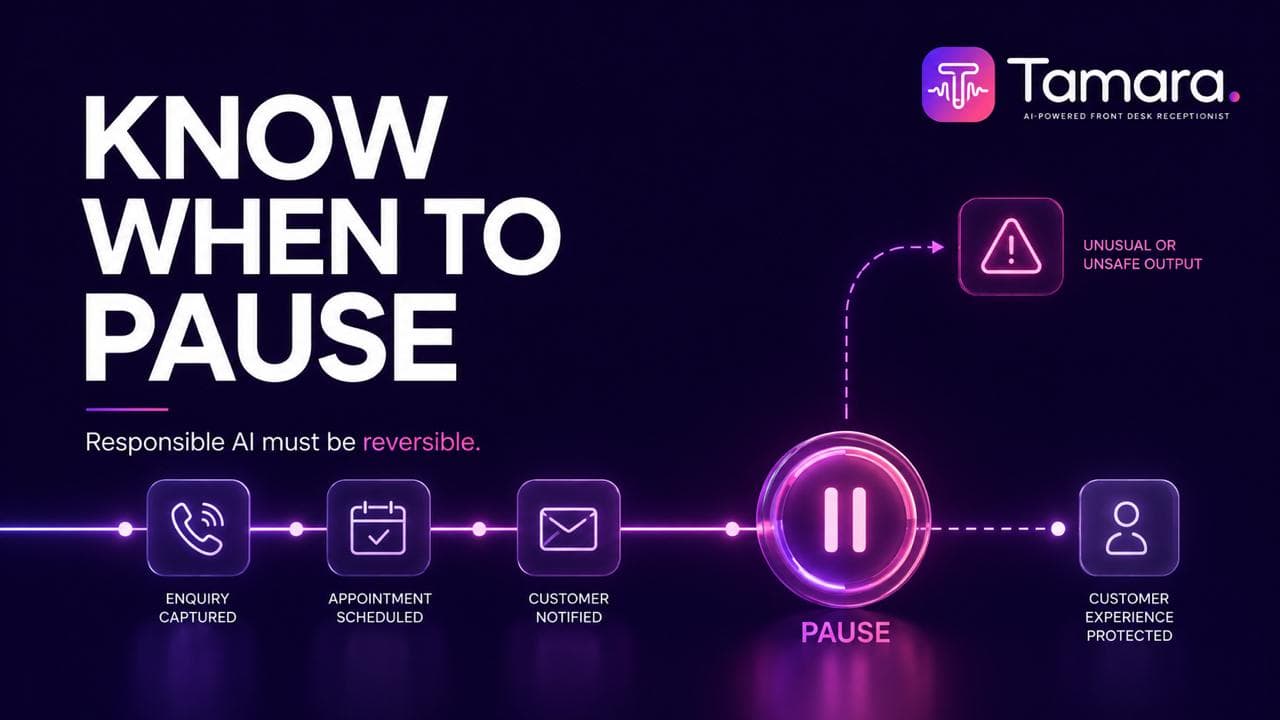
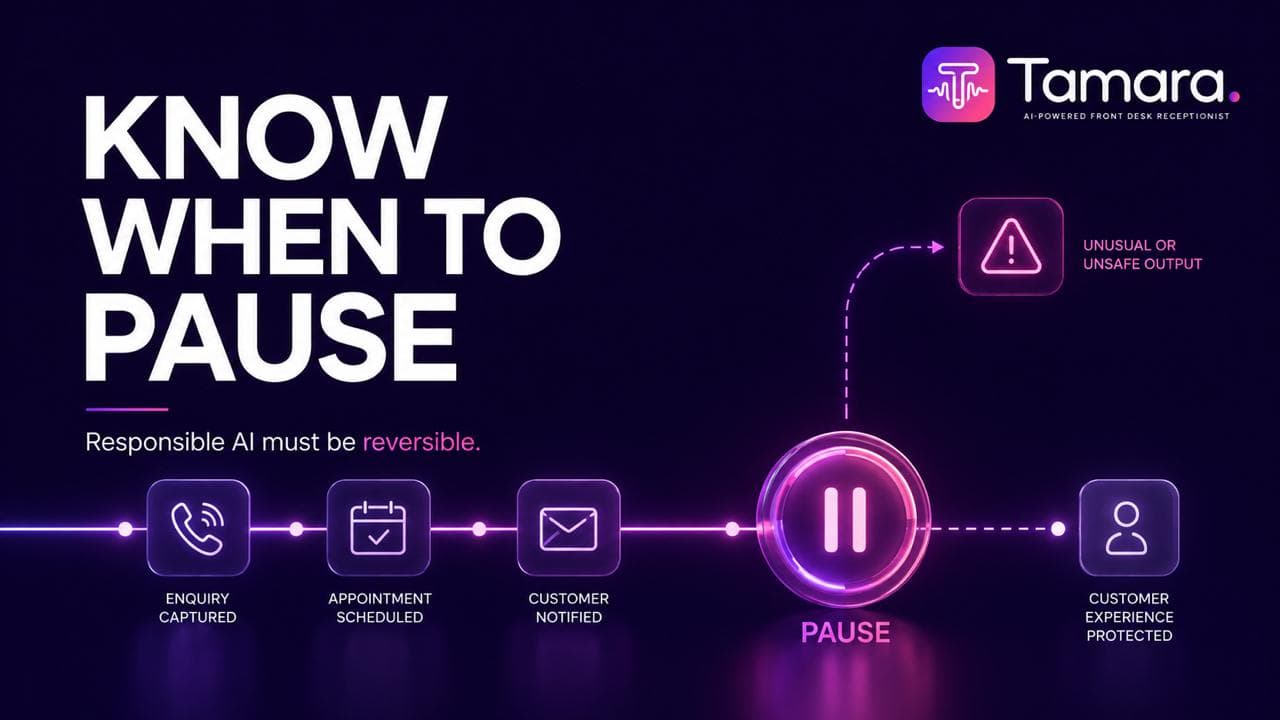
A company needs the ability to reverse an AI decision quickly.
AI launches are different from ordinary software launches
Traditional business software usually performs a defined set of actions.
A booking form collects the information included in its fields.
A calculator processes numbers according to established formulas.
A payment page follows a known transaction flow.
Generative AI behaves differently.
It can produce outputs that were never written in advance.
Users can enter unexpected instructions.
The system can combine information in ways the product team did not predict.
A seemingly harmless feature can create misleading, offensive or dangerous content when used outside its intended purpose.
This unpredictability does not mean businesses should avoid generative AI.
It means the launch process must account for uncertainty.
The safest AI launch may begin with fewer users
Companies often want to make a new feature available to everyone immediately.
A broad release generates attention.
It creates user activity.
It produces more data.
But it also increases the number of things that can go wrong at the same time.
A controlled launch gives the business an opportunity to observe real behaviour before exposure becomes too large.
The company might begin with:
Internal employees.
A small group of trusted customers.
One location.
One department.
One type of customer request.
A limited number of daily interactions.
A restricted set of approved actions.
This is not simply cautious product management.
It is a way to learn which risks actually appear in the real world.
Every AI pilot should answer one operational question
Businesses sometimes run pilots without defining what they are testing.
Employees experiment with a tool.
Customers try a feature.
The company gathers general feedback.
After several weeks, nobody knows whether the pilot succeeded.
A stronger pilot begins with a specific question.
For an AI-powered front desk, the question might be:
Can the system answer routine calls outside working hours without reducing customer satisfaction?
For appointment scheduling:
Can the system book approved appointment types without creating calendar conflicts?
For lead qualification:
Can the system identify high-intent prospects without rejecting valuable enquiries?
For customer support:
Can the system resolve the five most common questions without increasing complaint rates?
A pilot needs a measurable purpose.
Otherwise, the business may confuse activity with evidence.
Tamara should be introduced through controlled workflows
Tamara is being developed as an AI-powered front desk receptionist.
It can help businesses answer calls, capture enquiries, provide approved information, schedule appointments and route conversations.
But a responsible deployment should not begin by giving Tamara unrestricted access to every system in the business.
The first workflow might be simple.
Answer calls after normal working hours.
Capture the caller's name and contact information.
Record why the customer called.
Answer a limited set of approved questions.
Offer appointments only from a designated calendar.
Escalate complaints, emergencies and financial requests to a person.
This gives the business a clear area to test.
How many calls were answered?
How many enquiries were captured?
How many appointments were created correctly?
How often did the system escalate?
How many customers asked for a human?
What types of questions caused difficulty?
The company can learn from those results before expanding the system's responsibilities.
Real-time monitoring matters
An AI product cannot be managed only through a report produced at the end of the month.
If users are generating harmful outputs, the company needs to know quickly.
If an AI receptionist is repeatedly misunderstanding an important question, the company should not wait four weeks to discover the pattern.
If an automated process is booking appointments incorrectly, the business needs an alert before the calendar becomes unusable.
Important monitoring signals may include:
A sudden increase in complaints.
Repeated policy violations.
A sharp rise in failed actions.
Unusual access attempts.
Unexpected use outside approved hours.
High escalation rates.
Customers abandoning the conversation.
Repeated corrections by employees.
The purpose of monitoring is not only to detect a dramatic crisis.
It is also to identify small operational problems before they become large customer problems.
A rollback plan should exist before launch
Businesses spend time designing how a feature will go live.
They often spend less time planning how it will be stopped.
Before launching AI, the business should decide:
Who has authority to pause it?
Where is the control located?
Can one feature be disabled without taking down the entire service?
What happens to ongoing customer conversations?
How will staff handle requests manually?
How will affected customers be informed?
How will the company confirm that the problem has been resolved?
A rollback plan creates options.
Without one, managers may continue operating a flawed system because stopping it seems more disruptive than allowing the problem to continue.
Pausing is not the same as abandoning
An operational pause can serve several purposes.
The company may need to improve content filters.
It may need to narrow the type of prompts users can submit.
It may need stronger identity checks.
It may need clearer warnings.
It may need to change how outputs are displayed.
It may need human review for sensitive requests.
The goal is not to punish experimentation.
It is to return with a safer and more useful product.
Businesses should distinguish between three decisions:
Continue the feature without changes.
Pause the feature while controls are improved.
End the feature because the risks or costs exceed the expected value.
These are management decisions.
A company should be able to make them based on evidence.
Customer communication is part of the rollback
A technical team may understand why a feature was suspended.
Customers may simply experience something that worked yesterday and disappeared today.
That creates confusion.
A responsible pause should include a clear explanation.
The message does not need to disclose sensitive technical details.
It should tell customers:
Which feature is temporarily unavailable.
Why the business made the decision.
What customers can use instead.
Whether existing information remains safe.
When the company expects to provide another update.
Silence creates speculation.
Clear communication protects trust.
AI governance should not exist only at large technology companies
It is easy to view Google's experience as something relevant only to companies with billions of users.
The same principle applies to a clinic, hotel, airline, property business, school or professional-services company.
Suppose a clinic introduces AI appointment booking.
The system begins scheduling consultations into the wrong calendar.
The clinic needs to pause booking without disabling every customer-support function.
Suppose a hotel introduces an AI concierge.
The system starts promising discounts that management never approved.
The hotel needs to stop promotional responses while allowing the system to continue answering basic questions.
Suppose a financial company introduces automated customer support.
The AI begins giving inaccurate information about transaction reversals.
The business needs to move those questions to trained employees immediately.
A small company may have fewer customers.
It may also have fewer resources to absorb a serious mistake.
Controls matter at every scale.
Build AI systems in modules
One way to make rollback easier is to avoid creating one enormous system that controls everything.
A modular customer-operation system might separate:
Call answering.
Identity verification.
Frequently asked questions.
Appointment scheduling.
Payment confirmation.
Complaint escalation.
Customer notifications.
Human handover.
If the appointment module develops a problem, the business can suspend appointment creation while keeping the other functions available.
If payment confirmation is unreliable, that function can return to human review without shutting down call answering.
This is operational resilience.
The business can isolate the problem instead of losing the entire service.
Create a human fallback
AI should improve the customer journey.
It should not leave customers trapped when the technology is unavailable.
Every important automated workflow needs a fallback.
That fallback might be:
A live employee.
A callback request.
A manual booking form.
A support email.
A temporary voicemail with a defined response time.
A clearly communicated service-status page.
The fallback does not need to deliver the same speed as the automated service.
It needs to preserve continuity.
A customer should know what happens next.
Measure what happens after the pause
A company should not restore an AI feature simply because engineers believe the problem has been fixed.
The company should test whether the new control works.
Did policy violations decline?
Did the false-positive rate become unacceptable?
Can legitimate customers still complete the workflow?
Did the safeguard create additional friction?
Are employees receiving too many unnecessary alerts?
Does the human-review process have enough capacity?
A safeguard that blocks every customer may eliminate one risk while destroying the product's usefulness.
Good AI governance balances safety, reliability and customer experience.
Five questions before your next AI launch
Before making an AI feature available to customers, ask five questions.
1. What is the system allowed to do?
Define the approved job, data sources, tools and actions.
2. What could go wrong?
Identify customer harm, misinformation, privacy, security and operational risks.
3. How will we detect the problem?
Create alerts, logs and performance thresholds.
4. Who can stop the feature?
Assign clear authority and provide a direct control.
5. What will customers experience during the pause?
Prepare a fallback workflow and communication message.
These questions do not guarantee that nothing will go wrong.
They make the business better prepared to respond.
Responsible AI needs reversibility
Many AI discussions focus on intelligence.
How capable is the model?
How natural is the conversation?
How many tasks can it perform?
Operational leaders need to ask another question:
How reversible is the system?
Can access be removed?
Can a feature be isolated?
Can an action be reviewed?
Can a customer reach a person?
Can the business return temporarily to a manual process?
A system that cannot be reversed creates dependency before it creates resilience.
The best launch is not the one that never pauses
Google's decision to halt its Google Earth feature does not tell us whether the product will ultimately succeed.
The company may restore it with stronger safeguards.
It may narrow the feature.
It may redesign how users interact with it.
The important point is that Google retained the ability to intervene.
Businesses should approach AI with the same discipline.
Start with a defined workflow.
Limit access.
Monitor real behaviour.
Keep a human fallback.
Know how to pause.
Learn from the incident.
Then return with a stronger system.
The objective is not to build automation that can never be stopped.
It is to build automation that remains under control.