
July 23, 2026 · The Tamara Team
AI Investment Is Accelerating. Here's How Businesses Can Turn It Into Measurable Results.
Technology companies are increasing their investment in artificial intelligence infrastructure, and markets are paying attention.
Asian semiconductor shares rose on 23 July as investors responded to further AI spending by major US technology companies. South Korea's KOSPI gained more than 3 percent, supported by companies such as Samsung Electronics and SK Hynix, while investors continued assessing whether the billions being committed to AI will produce adequate returns. > (Source: Reuters, 23 July 2026)
The United States has also announced plans to spend $5 billion on AI-powered research in sectors including healthcare and construction. (Source: Reuters, 22 July 2026)
Separately, the United States and China are expected to hold discussions about artificial intelligence in September. (Source: Reuters, 21 July 2026)
Together, these developments show that AI is no longer being treated as an experimental software category.
It is becoming economic infrastructure.
But the most important question for businesses is changing.
The question is no longer:
"Should we use AI?"
The better question is:
"What measurable result should AI produce?"
AI spending is entering its accountability phase
The early phase of generative AI adoption was driven by experimentation.
Businesses subscribed to writing tools, image generators, chatbots and automated assistants. Teams tested prompts and created demonstrations. Executives wanted to show that their organisations were participating in the AI revolution.
Experimentation was necessary.
But experimentation is not the same as transformation.
A company can own several AI tools and still respond slowly to customers.
It can produce impressive reports while missing sales enquiries.
It can automate content production while its staff continue copying information manually between systems.
It can install a chatbot that answers basic questions but frustrates customers when the conversation becomes more complicated.
The existence of AI inside a company does not prove that the company is operating better.
Results do.
Start with a business problem, not an AI product
The most effective AI projects usually begin with a specific operational problem.
A business may notice that customer calls are frequently unanswered after working hours.
Another may discover that employees spend several hours each day answering the same questions.
A clinic may struggle to confirm appointments.
A property company may lose leads because enquiries are not followed up quickly.
A financial-services provider may have customers waiting too long for guidance about verification, deposits or account access.
These are measurable problems.
< Once the problem is clear, AI can be evaluated against practical outcomes.
- Did response time improve?
- Were more leads captured?
- Did appointment attendance increase?
- Were employees able to spend more time on complex work?
- Did customers receive consistent answers?
- Did the business reduce the cost of handling each enquiry?
These questions turn AI from an interesting technology into an operational investment.
The front desk is one of the clearest places to measure AI
For many businesses, customer communication is an ideal starting point because the results are visible.
Every incoming call has a purpose.
The caller may want to make a purchase, book an appointment, report a problem, confirm availability or request information.
When nobody responds, the opportunity may disappear.
A missed call is not simply a communication failure.
It may be lost revenue.
It may be a customer who chooses a competitor.
It may be a client whose frustration becomes a public complaint.
It may be an urgent request that becomes more expensive because it was not handled early.
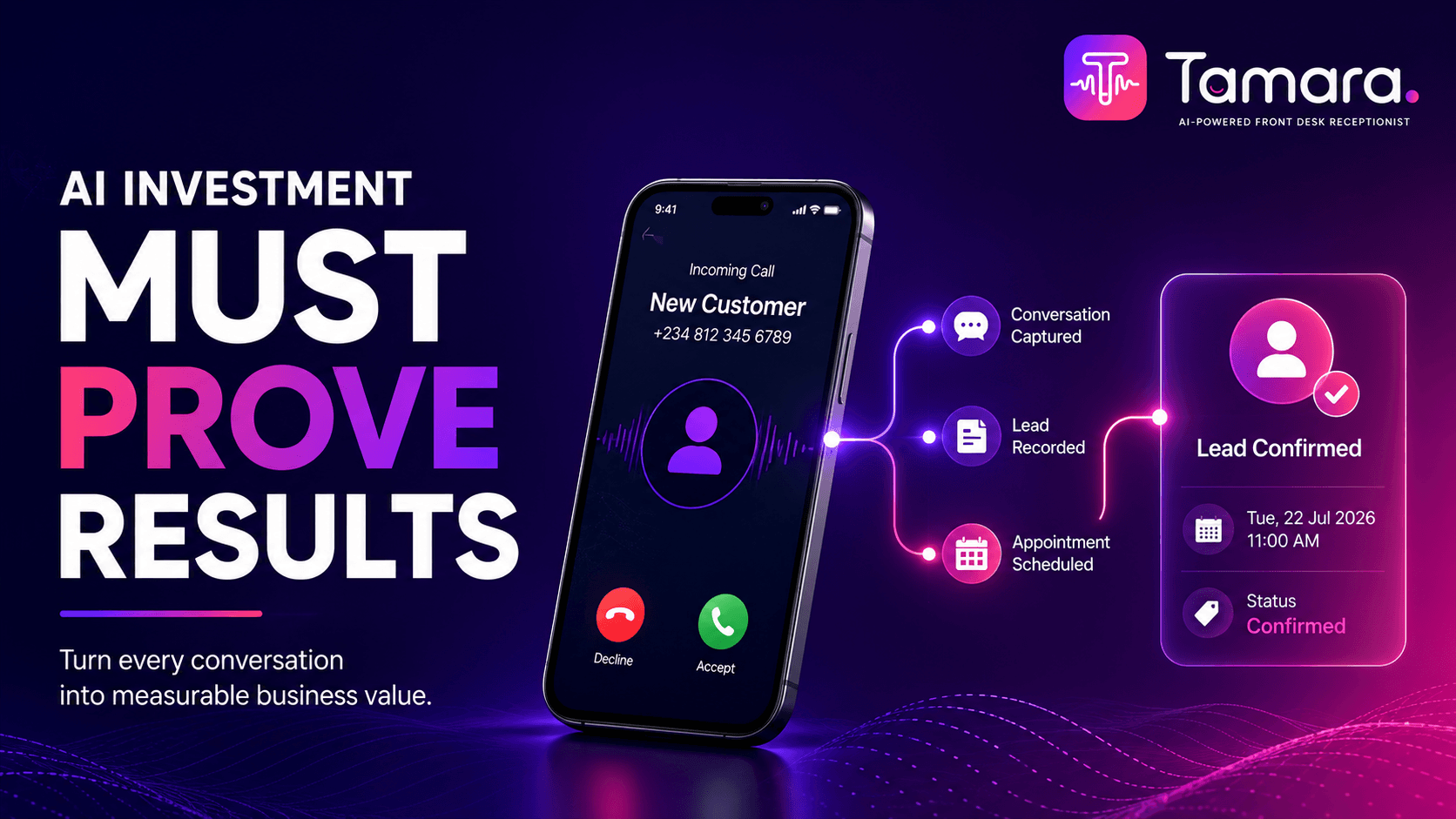
An AI-powered front desk can create measurable value by answering routine enquiries, capturing customer details, scheduling appointments, routing requests and escalating conversations that require human judgement.
The technology should not be judged by how human it sounds.
It should be judged by what happens after the conversation.
Was the customer helped? Was the enquiry recorded? Was the appointment confirmed? Was the correct employee notified? Was the lead followed up?
Those are business results.
Automation should strengthen the customer journey
Poorly designed automation often focuses only on reducing labour.
That is too narrow.
The strongest automation improves both efficiency and customer experience.
A useful system should make it easier for customers to receive help while giving employees better information.
For example, an AI receptionist can gather the caller's name, purpose and preferred contact time before transferring the conversation. That allows the next employee to begin with context instead of forcing the customer to repeat everything.
The same system may automatically send an appointment confirmation, create a lead record or route an urgent request to the appropriate team.
The value comes from the complete workflow, not only the conversation.
This is an important distinction.
AI should not become another disconnected tool that creates additional work.
It should connect the steps required to produce an outcome.
Human support still matters
AI does not eliminate the need for people.
It changes where human attention is most valuable.
Routine questions, basic appointment requests and simple information gathering can often be automated.
Complex complaints, sensitive financial issues, unusual requests and emotionally difficult conversations may still require human judgement.
A well-designed system knows when to escalate.
It also gives the employee enough information to continue the conversation properly.
The objective is not to remove people from customer service.
It is to prevent skilled employees from spending all their time performing repetitive tasks that technology can handle reliably.
Businesses need clear AI scorecards
Every AI project should have a small set of performance measures.
For customer communication, these may include:
1. Call-answer rate Average response time, 2. Qualified leads captured, 3. Appointments booked ,4. Appointment confirmation rate, 5. Successful transfers, 6. Human escalations Customer satisfaction (CSAT) Cost per interaction, 7. Revenue generated from captured enquiries.
These measures should be reviewed regularly.
If the system is not producing improvement, the workflow may need to be redesigned.
The problem may be inaccurate information, weak integration, unclear escalation rules or an automation that customers find difficult to use.
The correct response is not always to purchase another AI tool.
Sometimes the business needs a better process.
Africa's AI opportunity depends on practical implementation
An International Monetary Fund paper estimates that artificial intelligence could increase Sub-Saharan Africa's economy by around 4 percent over the next decade if the region improves electricity, internet access and digital skills. (Source: Reuters citing the IMF, 21 July 2026)
That potential is significant.
However, the IMF also warned that the economic benefit could be negligible without the necessary infrastructure and capabilities. (Source: Reuters citing the IMF, 21 July 2026)
The lesson for African businesses is similar.
Access to an AI model is not enough.
Companies need reliable connectivity, accurate business information, trained employees and workflows that convert technology into useful action.
The businesses that gain the greatest advantage will not necessarily be those that adopt the most tools.
They will be the ones that apply AI to important problems and measure the result.
AI must move from promise to performance
The global AI investment race is accelerating.
Governments are funding research.
Technology companies are building data centres.
Semiconductor manufacturers are benefiting from rising infrastructure demand.
Investors are watching closely.
But inside an ordinary business, the standard should remain simple.
- Does the technology help the company serve customers better?
- Does it reduce avoidable work?
- Does it capture opportunities that were previously lost?
- Does it make the business more reliable?
AI does not prove its value through a presentation.
It proves its value when a customer receives an answer, a lead becomes an appointment and a business can clearly measure the improvement.
# Final Thoughts
Artificial intelligence is rapidly becoming part of the world's economic infrastructure. Yet businesses will not succeed simply because they adopt AI. They will succeed when they use it to solve real operational problems and measure meaningful outcomes.
Whether your goal is reducing missed calls, improving customer response times, booking more appointments or helping your team focus on higher-value work, the most successful AI projects begin with a clear business objective and end with measurable business impact.
Technology creates possibilities.
Execution creates results.
How Tamara Helps
At Tamara, we believe AI should deliver measurable business outcomes, not just impressive demonstrations.
Tamara acts as an AI-powered front desk that answers calls 24/7, captures leads, books appointments, routes enquiries to the right people and ensures no customer opportunity is missed.
The goal is simple: help businesses respond faster, operate smarter and deliver a better customer experience while giving employees more time to focus on work that truly requires human expertise.
Because the true value of AI is not measured by how intelligent it sounds.
It is measured by the results it delivers.
Sources 1. Reuters. Asian stocks rise as AI capex ramps up. 23 July 2026. 2. Reuters. US to spend $5 billion on AI-powered research. 22 July 2026. 3. Reuters. US and China to hold AI talks. 21 July 2026. 4. Reuters. AI could lift Sub-Saharan Africa's economy by around 4% if infrastructure improves, IMF says. 21 July 2026.